
Roadster 3.0
Battery technology has continued a steady improvement in recent years, as has our experience in optimizing total vehicle efficiency through Model S development. We have long been excited to apply our learning back to our first vehicle, and are thrilled to do just that with the prototype Roadster 3.0 package. It consists of three main improvement areas.
1. Batteries
The original Roadster battery was the very first lithium ion battery put into production in any vehicle. It was state of the art in 2008, but cell technology has improved substantially since then. We have identified a new cell that has 31% more energy than the original Roadster cell. Using this new cell we have created a battery pack that delivers roughly 70kWh in the same package as the original battery.
2. Aerodynamics
The original Roadster had a drag coefficient (Cd) of 0.36. Using modern computational methods we expect to make a 15% improvement, dropping the total Cd down to 0.31 with a retrofit aero kit.
3. Rolling Resistance
The original Roadster tires have a rolling resistance coefficient (Crr) of 11.0 kg/ton. New tires that we will use on the Roadster 3.0 have a Crr of roughly 8.9 kg/ton, about a 20% improvement. We are also making improvements in the wheel bearings and residual brake drag that further reduce overall rolling resistance of the car.
Summary
Combining all of these improvements we can achieve a predicted 40-50% improvement on range between the original Roadster and Roadster 3.0. There is a set of speeds and driving conditions where we can confidently drive the Roadster 3.0 over 400 miles. We will be demonstrating this in the real world during a non-stop drive from San Francisco to Los Angeles in the early weeks of 2015.
Appointments for upgrading Roadsters will be taken this spring once the new battery pack finishes safety validation. We are confident that this will not be the last update the Roadster will receive in the many years to come.

X-37B Space Plane Returns: 5 Theories About Its Secret Mission
After spending nearly two years in orbit on a secret mission, the U.S. Air Force's mysterious X-37B space plane landed today (Oct. 17) at Vandenberg Air Force Base in California. The unmanned, reusable vehicle logged an unprecedented 675 days in space, but very little is known about the record-setting flight.
The X-37B, also known as the Orbital Test Vehicle, touched down at the Vandenberg Air Force Base today at 9:24 a.m. local Pacific Time (12:24 p.m. EDT). It was the third in a series of flights that the Air Force has conducted using its two X-37B planes.
This most recent flight, called OTV-3, was the third one to make it into orbit and was the longest mission, at 675 days. The program's inaugural mission launched in April 2010 and lasted 225 days. The space plane's second mission lasted 469 days.
New Smart ForSpeed Concept Hints
While Smart has no immediate plans to produce the ForSpeed, key styling elements such as the headlamp and tail lamp designs with the outer rings illuminated by a LEDs as well as the more prominent front grille, will be carried over to future products including the next ForTwo series and the new five-door ForFour as the company plans to create a more distinct look for its cars to better compete with the Fiat 500 and the Mini.

V-22 Osprey
crown jewel of hard work and high people and material cost. This machine can perform landing and take-off from very small and nasty places in which standard transport airplanes can only perform parachute drops. Amongst all it can reach up to 560 km/h in flight, carry 27 tons of cargo and reach up to 7,900 meters of height. United States Army had been given excellent machine.


SAIC Motor


2046 Parsonal Commuter


ZecOO Electric Bike


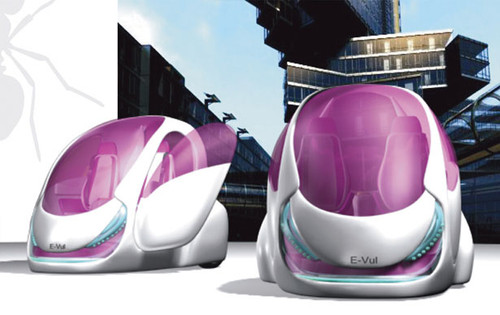
E-Vul Electric Car


Fiorella Yacht


Dune 90 Megayacht By Arman Fisette


Scoobike By Ardhyaska Amy


Subscribe to:
Posts (Atom)