Amantide Electric Trike

 The prime dependency for today’s transportation needs is on fossil fuels. These fossil fuels being non renewable in nature and contributors towards pollution, efforts should be made for increasing usage of alternative sources of energy. In the recent times, there have been quite some attempts towards developing two as well as four wheelers that run on electricity. The awareness towards these modes of transportation has also simultaneously increased.
 A recent invention that’s based on utilizing energy from electricity is the Amantide Electric Trike. This three wheeler mode of transportation designed by Florentin Hortopan has a revolutionary design. It has seating space for a single person, with one wheel to support on the backside, and two wheels on the front side, with leg rests attached to the extensions supporting these wheels.
 A handlebar attached near the base of the seat has an accelerator on the right hand side similar to a motorbike, whereas the braking mechanism for the trike is activated by pulling the entire handlebar towards the chest of the rider. Additionally, there is also a spring like suspension beneath the seat that acts as shock absorber for the jerks that might be encountered during riding the trike. The source of power, a rechargeable battery would also be located besides this spring suspension.
What makes this trike more desirable as well as (supposedly) theft proof, is the fact that post the ride, the user can fold it up and carry it with him to his next destination or store it inside his room/cubicle. No doubt, the trike looks elementary and maybe a tad funny, but there is no denying the fact that it is a safe and convenient alternative for commuting short distances and contributing a bit towards the environment.

Autonomous Sailboat

 You must have heard of UAVs (unmanned aerial vehicles), also called drones. But did you know that there are drone boats too? In fact, these autonomous sailing boats even have a world championship devoted exclusive to racing on the high seas. This year’s Microtransat Challenge — a transatlantic race — is planned to start between August 31st and September 30th 2011.
 These tiny ships have microprocessors to help with navigation but are propelled by the wind. The race takes between 40 and 60 days to complete. The boat, or call it a Ro-boat if you will, which crosses the Atlantic and reaches the finish line in the shortest time is the winner. To do this it has to battle a host of hostile conditions. These include facing storms, winds of over 50 knots, tropical storms and even hurricanes common in latitudes close to Ecuador.

The microprocessor has to decide the course of the boat based on wind speed, weather conditions, etc…all without any human intervention. Before leaving, each team must
choose a field of 50 kilometers in diameter along the fixed line.

Man sure has come a long time from rickety rafts and boats with oars which could barely cross rivers, leave aside oceans. Wonder what Columbus would have thought of tiny robotic boats making the same journey that he did in a fraction of his time and most importantly with much greater accuracy.

These tiny sail boats require a lot of time and research and very few actually manage to complete the journey. Last year, only the team from Aberystwyth University were able to launch during this time.

In order to avoid collision at sea, the boats are equipped with an AIS class B transponder. Additionally, for it’s remote tracking they have a satellite transponder. Tech that, Columbus.

Eco Slim Caramaran

 Here is a catamaran that is lighter than its counterparts and is powered by renewable energy. This catamaran built by boat-builder Drassanes Dalmau doesn’t demand a very powerful engine as in conventional boats. The credit of the design of propulsion system goes to the team of Jordi Llorca of Institute of Energy Technology, Prof Victor Fuses and Prof Ricard Bosch of the Department of Electrical Engineering and one PhD student.

One important innovation used in the propulsion system is its design that uses two electric motors connected to multiple energy sources: a diesel generator and a set of 90 lead batteries. This enables the boat to navigate for four hours continuously at six or seven knots. The batteries and the motor can be charged in an hour and half.
 This boat, ‘Eco Slim’ has a seating capacity of 150, its length and width is 24 m and 10.5 m respectively. It is intended mainly for tourism, unlike other boats meant for inland waterways.
Eco Slim can cruise at eight knots. It gets power by electricity generated by solar panels, wind turbines, batteries and diesel-engine thermal generators, which makes it environment friendly.
The hull of the boat is special because it uses vacuum infusion system. Drassanes Dalmau got it constructed with the help from Isonaval. The boat was built following the process used in manufacturing car bodywork. Under this, the port and starboard were joined together after being made separately. As a result, the weight gets reduced by 50 per cent as compared to the traditional models. Also, the hydrodynamic lines of the boat has helped in reducing the hydrodynamic resistance by 20 per cent, which actually makes a huge difference. These features have enabled the boat to work using less powerful engines.

Green Bug

Green plants specially trees give streets and roadsides a very fresh and relaxed sight. They not only provide shade but also filter air making it clean for living beings. But like anything else even trees need to be maintained. Lim Wan Xuan with her teammates Tang Xueling Jane, Dominic Poon Chit Hong, Joanne Teoh Ee Mei has designed Green Bug which will be of great help in terms of urban agriculture.

It will give every tree its own unique identity, as every tree will be clipped with a chip which will work in association with GIS system. This will act as an interconnected system facilitating a lot of tree maintenance processes. With the help of RFID and GIS systems, it will become easy to scrutinize and handle/cure trees. This cute and compact vehicle will give trees in Milan an all new life. The car is powered by an air engine as electricity is used to compress air in the air tanks. This makes sure that are no emissions from the vehicle.

It has a compact telescopic seat platform that makes good use of gyroscopic sensor technology along with vertical lift hydraulic technology. Trees can be pruned with the help of an innovative waterjet technology, to keep them in a healthy state. Charging the battery of Green Bug doesn’t come with any special instructions. It takes 3-4 hours to get fully charged with electricity or if you take the car till a fuel station, refueling will hardly consume 2-3 minutes of your life. A single charge will allow Green Bug to cover 200-300 km.

Making light work of it: The world's first solar power station that generates electricity at NIGHT

 It looks like a giant art project. But this symmetrical, circular pattern of mirrored panels is the world's first solar power station that generates electricity at night.


The Gemasolar Power Plant near Seville in southern Spain consists of an incredible 2,650 panels spread across 185 hectares of rural land.


The mirrors - known as heliostats - focus 95 per cent of the sun's radiation onto a giant receiver at the centre of the plant.


Heat of up to 900C is used to warm molten salt tanks, which create steam to power the £260million station's turbines.

But, unlike all other solar power stations, the heat stored in these tanks can be released for up to 15 hours overnight, or during periods without sunlight.


The regular sunshine in southern Spain means the facility can therefore operate through most nights, guaranteeing electrical production for a minimum of 270 days per year, up to three times more than other renewable energies.

The project, a joint venture between Abu Dhabu energy company Masdar and Spanish engineering firm SENER called Torresol Energy, took two years to construct at a cost of £260million.


It is expected to produce 110 GWh/year - enough to power 25,000 homes in the Andalucia region.

FOTON 1


Flaunting its sleek and magnificent design is the new FOTON 1 Yacht. It is a kind of giant power yacht, which lets you have a comfortable cruise over the deep blue sea. With a horsepower of 8600 and with a top speed of 65 knots, one can comfortably enjoy the speed this yacht offers. The yacht has been designed using composite materials primarily carbon. Weighing about 80 tons, the mix of low saturated colors add up to the beauty of this boat. The design appears to be quite innovative with magnificent glass cabin. Speed characteristics of FOTON 1 make it exclusive in its class.

Sanca Genesis GT By Arifin Santosa

The age of supercars has dawned and each model that reaches the market brings with it a ‘wow’ factor. With power, speed and looks to kill, they come with a heavy price tag as well. For times immemorial now, Ferrari Enzo has been synonymous with Enzo based supercars, and designers now envisage the exclusive debutant, Genesis Sanca as nothing short of being the new age Ferari Enzo.
 The intricate handwork of three distinguished and highly experienced designers in the international automotive industry, Genesis Sanca is crafted to perfection with an impeccable blend of aesthetics, looks, performance, technology and safety.
 The brains behind this trend setter model have worked tirelessly and engineered this design to raise the bar for the standards in the sector; what else could one expect if above 19,000 man hours has led to such a master piece creation. A design primarily developed by Arifin Santosa, it was conceptualized way back in 2007.
In 2008, the first 1:4 layout of the Sanca was brought out. Consecutively, many tests and research processes were being conducted, rather rigorously for three years and only now, on April 14 it will be exhibited in the famous Top Marques Monaco.
If you are simply crazy about speed and performance and are willing to pay the price to flaunt some brilliance, then this car has plenty of things in store for you. Boasting of a chic and classy carbon monocoque frame and a Chevrolet Corvette ZR-1 engine with a fabulous capacity 647 hp, this car looks sexy in its bold black exterior. Needless to say, its interiors are extremely flamboyant as well.
 It also has many other technically advanced features, like a six-speed Xtrac Synchromesh Transaxle gearbox, carbon ceramic breaks and many more. It weighs about 1350kg and measures 4.3 meters long, making it an ideal pick for a supercar fanatic.
 Developers of the Genesis Sanca say that the car can accelerate to above 100km per hour in 3.4 seconds and can reach a top speed of 330 km per hour. Quite undoubtedly, this new age technical genius has created a league for itself in the market.

Volkswagen Aqua concept hovers clean on fuel cells and electric motors


Transportation has transcended to a completely different domain in the last few decades. From wheels to supersonic flying machines, we have invented almost everything which seemed impossible a few decades ago. Following the legacy of innovations, reckoned automobile manufacturer Volkswagen has come up with The Volkswagen Aqua, a futuristic hovercraft. Designed by Chinese designer Yuhan Zhang, a graduate from Xihua University in Industrial Design, the concept is proposed to be manufactured from lightweight yet a very durable material. This hovercraft is meant for use in lakes, rivers, coastal water or even on snow.


The acclaimed CDN Car Design Awards China committee shortlisted this hovercraft under the “Chinese off-road Vehicle” category, which speaks itself about the utility of this vehicle. The concept is installed with two motors, the primary is powered by a hydrogen fuel cell and is used to drive the main fan which inflates the skirt around the vehicle and raises the Aqua just above the ground. On the other hand, the fans at the rear of the vehicle are powered by individual electric motors to provide forward thrust and directional control. Despite its extremely simple and clean design, this hovercraft dons a royal and luxurious look and can easily accommodate two people

Go!Bus Double Decker By Ruben Oya

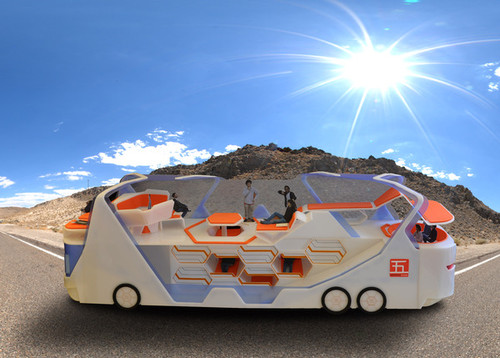
 A journey with friends is always a joy ride. This design by Ruben Oya is extremely interesting and looks like fun too. It is a double-decker that can accommodate 7 seven people. It has a transparent deck where you can enjoy the sites in the safety of your wonder vehicle. The only advise would be to stock up on fuel because getting lost in some God forsaken place will not be pretty. Especially if you are seen in an overly colourful moving cabin! The design also includes seats and beds to sleep in. interesting